Table of Contents
- Signs Your Dishwasher Is Not Draining Water
- What You’ll Need Before You Start
- Step 1: How to Clean Dishwasher Filter and Check for Debris
- Step 2: Fix a Dishwasher Drain Hose Clog or Kink
- Step 3: Check the Drain Pump, Air Gap, and Garbage Disposal Connection
- Step 4: Reset the Control Panel and Run a Drain Cycle
- Dishwasher Drain Pump Replacement Cost and When to Call a Pro
- How to Keep Your Dishwasher Draining: Maintenance Schedule
- Frequently Asked Questions
Last Updated: September 28, 2026
Signs Your Dishwasher Is Not Draining Water
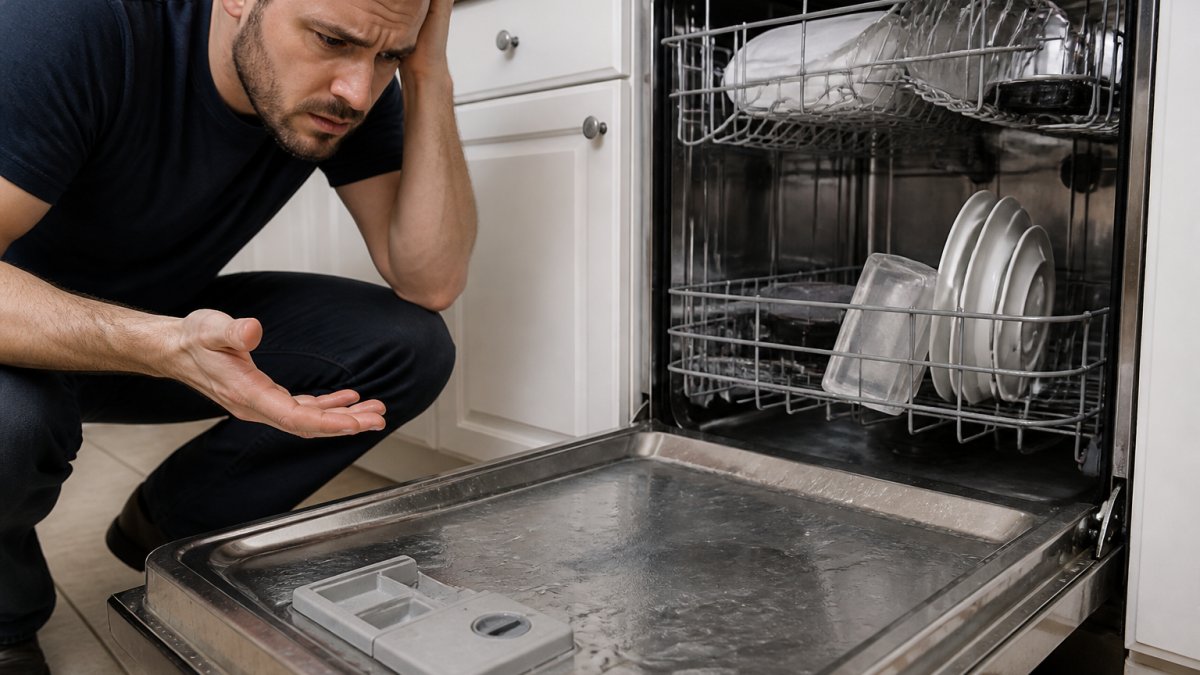
Standing water in the tub is the clearest sign of a dishwasher not draining. Most cases come down to a clogged filter, kinked hose, or jammed pump.
- Water pooling in the tub after a full cycle finishes
- A faint, musty smell from trapped food particles
- Dishes that come out gritty or still coated in soap
- A humming sound with no water movement during the drain cycle
- Error codes on the control panel pointing to a drainage fault
What You’ll Need Before You Start
Gather your tools first. Most are already in a basic household kit.
- Towels and a shallow pan or cup for scooping water
- A bucket to catch draining water
- Screwdriver set (Phillips and flathead)
- Adjustable pliers or a small wrench
- Flashlight or phone light
- Rubber gloves
- White vinegar and baking soda for cleaning
Never skip the power cut. Reaching into a dishwasher with the breaker on risks a serious shock, especially with standing water in the tub.
Step 1: How to Clean Dishwasher Filter and Check for Debris
The filter is the number one cause of a dishwasher not draining, and cleaning it is the fastest fix. Most modern dishwashers have a two-part filter assembly at the tub floor: a cylindrical filter and a flat screen underneath.

- Remove the bottom rack so you can reach the tub floor.
- Twist the cylindrical filter counterclockwise and lift it out.
- Pull up the flat filter screen beneath it.
- Rinse both under warm running water.
- Scrub away food particles and grease with a soft brush and dish soap.
- Check the sump area for debris, glass, or bones that block the impeller.
- Reinstall both filters and lock the cylinder back in place.
Run your faucet on hot for a minute before starting a load. Hot water breaks down grease faster and helps the drain cycle clear food particles instead of letting them settle into the filter.
Step 2: Fix a Dishwasher Drain Hose Clog or Kink
A dishwasher drain hose clog or kink is the second most common culprit. The hose carries used water from the pump to your sink drain or disposal, so a sharp bend or debris stops water from leaving the tub.
Check the hose in three places:
- Behind the dishwasher where it exits the cabinet
- Under the sink where it connects to the disposal or drain pipe
- Anywhere it loops or turns sharply
Step 3: Check the Drain Pump, Air Gap, and Garbage Disposal Connection
If the filter and hose are clear, the problem lives in one of three places: the garbage disposal connection, the air gap, or the drain pump. These parts form a chain, and the trick is figuring out which link is broken before you start unscrewing things.
Pick Your Path by Symptom
Use this decision tree instead of guessing:
- Water backs up into the sink when the dishwasher drains → the shared drain line or disposal is clogged. Start with the disposal.
- Water drains slowly but does drain, and you hear gurgling at the sink → the air gap is partially blocked. Start with the air gap.
- Tub holds water, you hear a hum or grind during the drain cycle, and nothing moves → the pump is running but jammed. Start with the pump impeller.
- Tub holds water and you hear nothing at all during the drain cycle → the pump is not getting power or has failed. Test the pump and its circuit.
- Water drains, then siphons back in after the cycle → a missing or failed air gap or a missing high-loop in the drain hose. This is a backflow problem, not a clog.
The Garbage Disposal Connection
If your dishwasher drains into a disposal, this is the fastest check and the most common fix. Run the disposal with water on for 15 to 20 seconds. If it sounds sluggish or hums without spinning, it is jammed, and a jammed disposal backs water straight up the dishwasher drain line.
Two disposal-specific traps catch people:
- The knockout plug. On a newly installed disposal, a plastic plug caps the dishwasher inlet port. If the installer forgot to punch it out, the dishwasher has literally nowhere to drain. This is a classic “it worked before the disposal was replaced” failure.
- The high loop. The dishwasher drain hose must rise above the disposal inlet before it connects, creating an air break. If the hose sags below the connection, dirty sink water siphons back into the tub. Secure the hose to the underside of the countertop so the high point stays high.
The Air Gap
The air gap is the small cylinder on the sink deck next to the faucet. It breaks the siphon between the dishwasher and the drain so dirty water cannot flow backward; when it clogs, water pools in the tub.
To clear it:
- Pull off the decorative cap on top.
- Lift out the inner plastic cover.
- Look for food debris, grease, or a buildup of mineral scale in the body.
- Flush it with hot water and clear any blockage with a bottle brush or a length of wire.
- Reassemble and run a drain cycle to test.
The Drain Pump
- Listen during the drain cycle. A healthy pump hums steadily and moves water. Silence means no power or a dead winding. A grind or rattle means something is jammed in the impeller.
- Cut power at the breaker, then remove the pump cover or the sump access panel per your model’s layout.
- Reach into the impeller housing with gloved fingers and check for glass, bones, seeds, or a twist tie wrapped around the impeller. This is the single most common pump jam.
- Spin the impeller by hand. It should turn freely with light resistance. If it will not turn, the obstruction or a seized bearing is your problem. If it spins freely but the pump still will not run, the motor or its capacitor has failed.
- Check the pump’s electrical connector for corrosion or a loose fit before condemning the pump.
Never reach into the pump housing or sump with the breaker on. Standing water plus a live pump circuit is a serious shock hazard. Confirm power is off at the breaker, not just at the control panel.
Work the chain in order, disposal, air gap, pump, and match the check to your symptom using the decision tree above. Most “dishwasher not draining” calls resolve at the disposal or air gap, well before the pump needs replacing.
If the impeller is clear, spins freely, and the pump still will not run, the pump has failed and needs replacement, a job where a professional diagnosis saves you from buying the wrong part.
BOOK YOUR SERVICE REPAIR TODAY →
Step 4: Reset the Control Panel and Run a Drain Cycle
Sometimes the fix is electronic. A power glitch, door-latch fault, or float switch stuck in the “full” position can leave the control board waiting for a signal that never comes, so the drain cycle never fires. Rule out the electronics before you pull the pump.
The standard reset sequence:
- Press Cancel or Drain and hold it for three seconds.
- If the panel is unresponsive, cut power at the breaker for a full 60 seconds, not 10, not 20. The control board holds a residual charge, and a short flip often does not clear it.
- Restore power, latch the door firmly, and select a short Rinse Only or Drain cycle.
- Listen at the sink. You should hear the drain pump kick on within 30 to 60 seconds of the cycle starting.
Reading the Error Code Before You Reset
Do not reset first and ask questions later. Write down any code on the display before you cut power, because a hard reset wipes the fault memory on many models. Drainage-related codes cluster around a handful of families, and the pattern is more useful than the exact number:
- Float / water-level codes (commonly labeled with an F or E plus a low digit, or a dedicated “water” icon) point to a float switch or pressure sensor that thinks the tub is still full. Check for a float stuck under a food particle or a sensor hose with water in it.
- Drain / pump timeout codes (often E1, E4, F2, or a pump icon) mean the board ran the pump for its allotted window, typically 60 to 120 seconds, and never saw the water level drop. That is a mechanical blockage or a dead pump, not a board fault.
- Communication or door-latch codes can masquerade as drain failures because the board aborts the cycle mid-drain. If the code references the latch or a communication bus, the drain system may be fine.
Photograph the display with your phone the moment a code appears. You keep the exact code, the cycle stage, and the time, all of which speed up diagnosis whether you fix it yourself or hand it to a technician.
When a Reset Will Not Help
A reset only clears a stuck state, not a physical clog, a burned-out pump winding, or a float switch jammed by debris. If you have reset twice and the tub still holds water, stop and move to the mechanical checks: filter, hose, air gap, disposal, then pump.
Dishwasher Drain Pump Replacement Cost and When to Call a Pro
Dishwasher drain pump replacement cost varies by model and part, so we cannot quote a flat figure. Pricing depends on the pump your unit needs, the labor, and how easy the dishwasher is to access. Book a service call and we will give you a clear quote before any work begins.
Call a professional if you notice any of these:
- The pump hums but never moves water
- You see a cracked or leaking pump housing
- The motor trips the breaker
- Water leaks from under the unit
- Your dishwasher is built-in and hard to pull out
U.S. Department of Energy appliance energy guidance
How to Keep Your Dishwasher Draining: Maintenance Schedule
Regular maintenance stops clogs before they start. A few minutes each month keeps your drainage system clear.
| Task | How Often | Why It Matters |
|---|---|---|
| Rinse the filter assembly | Weekly | Stops food particles from reaching the pump |
| Run a hot water + vinegar cycle | Monthly | Breaks down grease and odors |
| Check the drain hose for kinks | Monthly | Keeps water flowing freely |
| Inspect the air gap | Every 3 months | Prevents backflow and standing water |
| Run the disposal before a load | Each use | Clears the shared drain path |
| Deep clean the tub and door seal | Every 6 months | Removes buildup that causes smells |
Frequently Asked Questions
Why is there standing water in the bottom of my dishwasher?
Standing water usually means something is blocking the drain path. The most common culprits are a clogged filter assembly, food particles trapped in the drain hose, or a kinked hose behind the unit. Start by removing and rinsing the filter, then check the drain hose for kinks or blockages. If water still sits after a drain cycle, the drain pump or air gap may need attention.
Can a dirty filter cause a dishwasher not to drain?
Yes. The filter assembly catches food particles and debris before they reach the drain pump. When it gets clogged, water cannot flow through fast enough, so it pools at the bottom of the tub. Cleaning the filter every one to two months keeps water moving. If your dishwasher not draining water issue started gradually, a dirty filter is often the first thing to check.
How do I know if my dishwasher drain pump is bad?
A failing drain pump often makes a humming or grinding noise during the drain cycle but moves no water. You may also hear nothing at all when the cycle reaches the drain phase. Before assuming the pump is bad, clear the filter and check the drain hose for clogs. If those are clear and water still will not drain, the pump or its impeller is likely the problem.
Should I use chemicals to unclog my dishwasher drain?
Chemical drain cleaners can damage rubber seals, plastic components, and the drain pump inside your dishwasher. A safer approach is to physically remove the blockage: clean the filter, flush the drain hose, and check the air gap. For stubborn grease buildup, a mixture of baking soda and vinegar followed by a hot water rinse works well without harming internal parts.
Leave a Reply